
The Far-Reaching Implications of Brazil’s Supreme Court Decision for Platform Governance
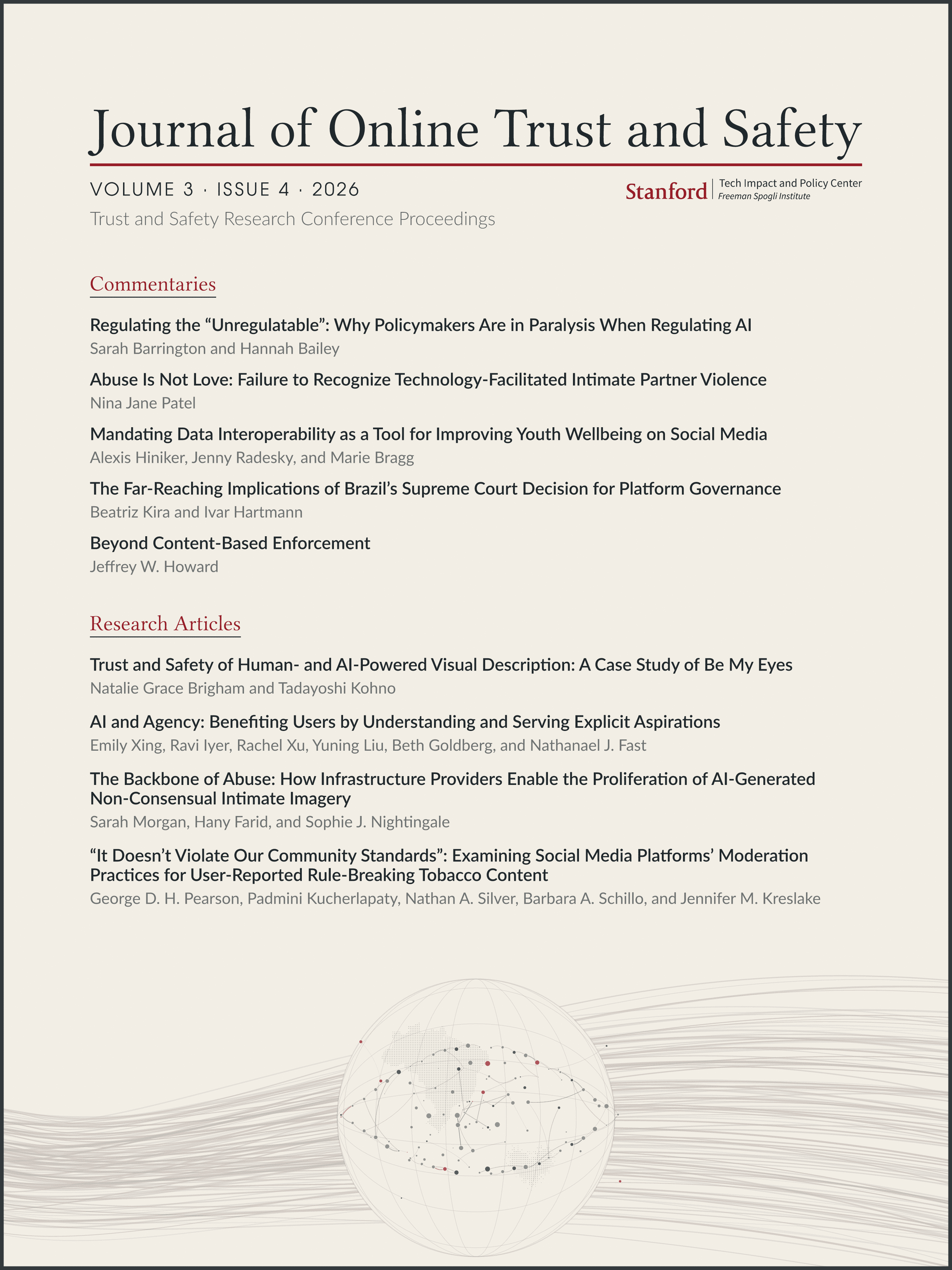
Cover of the Journal of Online Trust and Safety, Volume 3, Issue 4, 2026. The journal's name runs across the top in a large serif face over a thin red rule. Below it, on the left, "Volume 3 · Issue 4 · 2026" in spaced small capitals and the subtitle "Trust and Safety Research Conference Proceedings" in light gray; on the right, the Stanford Tech Impact and Policy Center, Freeman Spogli Institute wordmark. The contents follow in two sections with red serif headings. Under "Commentaries": "Regulating the 'Unregulatable': Why Policymakers Are in Paralysis When Regulating AI" by Sarah Barrington and Hannah Bailey; "Abuse Is Not Love: Failure to Recognize Technology-Facilitated Intimate Partner Violence" by Nina Jane Patel; "Mandating Data Interoperability as a Tool for Improving Youth Wellbeing on Social Media" by Alexis Hiniker, Jenny Radesky, and Marie Bragg; "The Far-Reaching Implications of Brazil's Supreme Court Decision for Platform Governance" by Beatriz Kira and Ivar Hartmann; and "Beyond Content-Based Enforcement" by Jeffrey W. Howard. Under "Research Articles": "Trust and Safety of Human- and AI-Powered Visual Description: A Case Study of Be My Eyes" by Natalie Grace Brigham and Tadayoshi Kohno; "AI and Agency: Benefiting Users by Understanding and Serving Explicit Aspirations" by Emily Xing, Ravi Iyer, Rachel Xu, Yuning Liu, Beth Goldberg, and Nathanael J. Fast; "The Backbone of Abuse: How Infrastructure Providers Enable the Proliferation of AI-Generated Non-Consensual Intimate Imagery" by Sarah Morgan, Hany Farid, and Sophie J. Nightingale; and "'It Doesn't Violate Our Community Standards': Examining Social Media Platforms' Moderation Practices for User-Reported Rule-Breaking Tobacco Content" by George D. H. Pearson, Padmini Kucherlapaty, Nathan A. Silver, Barbara A. Schillo, and Jennifer M. Kreslake. Each title is in bold dark gray with its authors in lighter gray beneath. The lower third of the cover is artwork in the same muted palette: a wireframe globe drawn in thin gray lines, cut off by the bottom edge, with a dotted map of Brazil on its face, a small soft-edged halftone heart to its lower right, and a network of gray and red nodes joined by curved lines that together trace the outline of an eye. Faint fanned waves of gray and pale red lines sweep across the lower page behind and around the globe. A thin dark gray frame runs just inside the edge of the cover.
PDF

Keywords

intermediary liability
platform regulation
Marco Civil da Internet
duty of care
Brazil

Categories

How to Cite

Kira, B., & Alberto Glasherster Lange Hartmann, I. (2026). The Far-Reaching Implications of Brazil’s Supreme Court Decision for Platform Governance. Journal of Online Trust and Safety, 3(4). https://doi.org/10.54501/jots.v3i4.308

Abstract

In October 2025, Brazil’s Federal Supreme Court declared Article 19 of the Marco Civil da Internet partially unconstitutional, fundamentally restructuring the country’s intermediary liability regime. For nearly a decade, platforms could only be held liable for third-party content upon failing to comply with a specific judicial removal order, subject to limited statutory exceptions. Concluding that this model no longer afforded adequate protection to fundamental rights and democratic institutions, the Court replaced it with four distinct liability regimes while introducing a duty of care alongside new transparency and due-process obligations. This commentary examines the ruling and situates it within Brazil’s institutional and political context, arguing that this decision reaches far beyond the allocation of liability in individual cases to influence broader governance arrangements applicable to digital platforms. Although adopted through constitutional adjudication rather than changes in legislation, the decision responded to pressing structural concerns and shifted Brazilian platform regulation toward a preventive, risk-oriented model that has helped to shape a hybrid framework combining judicial standards with regulatory supervision.

https://doi.org/10.54501/jots.v3i4.308
PDF
Creative Commons License

This work is licensed under a Creative Commons Attribution-NonCommercial-ShareAlike 4.0 International License.

Copyright (c) 2026 Beatriz Kira, Ivar Alberto Glasherster Lange Hartmann