
Trust and Safety of Human- and AI-Powered Visual Description: A Case Study of Be My Eyes
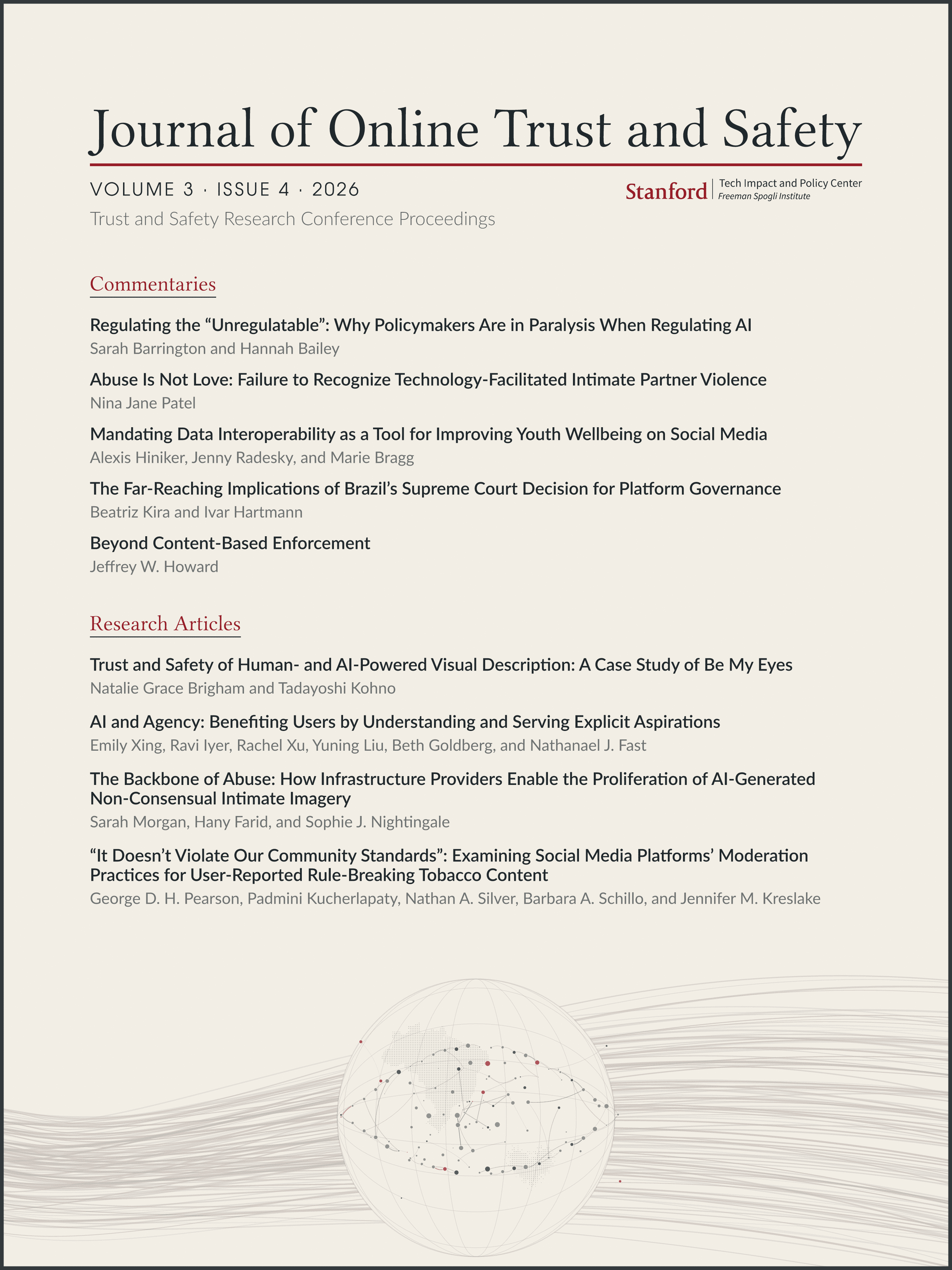
Cover of the Journal of Online Trust and Safety, Volume 3, Issue 4, 2026. The journal's name runs across the top in a large serif face over a thin red rule. Below it, on the left, "Volume 3 · Issue 4 · 2026" in spaced small capitals and the subtitle "Trust and Safety Research Conference Proceedings" in light gray; on the right, the Stanford Tech Impact and Policy Center, Freeman Spogli Institute wordmark. The contents follow in two sections with red serif headings. Under "Commentaries": "Regulating the 'Unregulatable': Why Policymakers Are in Paralysis When Regulating AI" by Sarah Barrington and Hannah Bailey; "Abuse Is Not Love: Failure to Recognize Technology-Facilitated Intimate Partner Violence" by Nina Jane Patel; "Mandating Data Interoperability as a Tool for Improving Youth Wellbeing on Social Media" by Alexis Hiniker, Jenny Radesky, and Marie Bragg; "The Far-Reaching Implications of Brazil's Supreme Court Decision for Platform Governance" by Beatriz Kira and Ivar Hartmann; and "Beyond Content-Based Enforcement" by Jeffrey W. Howard. Under "Research Articles": "Trust and Safety of Human- and AI-Powered Visual Description: A Case Study of Be My Eyes" by Natalie Grace Brigham and Tadayoshi Kohno; "AI and Agency: Benefiting Users by Understanding and Serving Explicit Aspirations" by Emily Xing, Ravi Iyer, Rachel Xu, Yuning Liu, Beth Goldberg, and Nathanael J. Fast; "The Backbone of Abuse: How Infrastructure Providers Enable the Proliferation of AI-Generated Non-Consensual Intimate Imagery" by Sarah Morgan, Hany Farid, and Sophie J. Nightingale; and "'It Doesn't Violate Our Community Standards': Examining Social Media Platforms' Moderation Practices for User-Reported Rule-Breaking Tobacco Content" by George D. H. Pearson, Padmini Kucherlapaty, Nathan A. Silver, Barbara A. Schillo, and Jennifer M. Kreslake. Each title is in bold dark gray with its authors in lighter gray beneath. The lower third of the cover is artwork in the same muted palette: a wireframe globe drawn in thin gray lines, cut off by the bottom edge, with a dotted map of Brazil on its face, a small soft-edged halftone heart to its lower right, and a network of gray and red nodes joined by curved lines that together trace the outline of an eye. Faint fanned waves of gray and pale red lines sweep across the lower page behind and around the globe. A thin dark gray frame runs just inside the edge of the cover.
PDF

Keywords

Be My Eyes
visual description
blind and low vision users
app reviews
policy analysis

Categories

How to Cite

Brigham, N. G., & Kohno, T. (2026). Trust and Safety of Human- and AI-Powered Visual Description: A Case Study of Be My Eyes. Journal of Online Trust and Safety, 3(4). https://doi.org/10.54501/jots.v3i4.340

Abstract

Be My Eyes provides a volunteer-powered visual description service that connects over one million blind and low vision users with more than ten million volunteers for everyday visual assistance tasks as well as Be My AI, an AI-powered counterpart. In this work, we qualitatively analyze 1,428 one-, two-, and three-star reviews from the Apple App Store and Google Play Store to holistically examine the concerns and harmful experiences of both users and volunteers. Our analysis surfaces online harassment and abuse (trolling, cyberflashing, reporting failures), privacy concerns beyond information exposure (data use for model training), and accessibility/safety problems (inaccurate descriptions, paternalistic guardrails). We additionally analyze platform policies to examine whether and how these issues are addressed by them. Based on challenges we find related to accessibility, security, privacy, and AI, we provide recommendations for strengthening trust and safety on visual description services that serve blind and low vision people’s access needs.

https://doi.org/10.54501/jots.v3i4.340
PDF
Creative Commons License

This work is licensed under a Creative Commons Attribution-NonCommercial-ShareAlike 4.0 International License.

Copyright (c) 2026 Natalie Grace Brigham, Tadayoshi Kohno