
Regulating the “Unregulatable”: Why Policymakers Are in Paralysis When Regulating AI
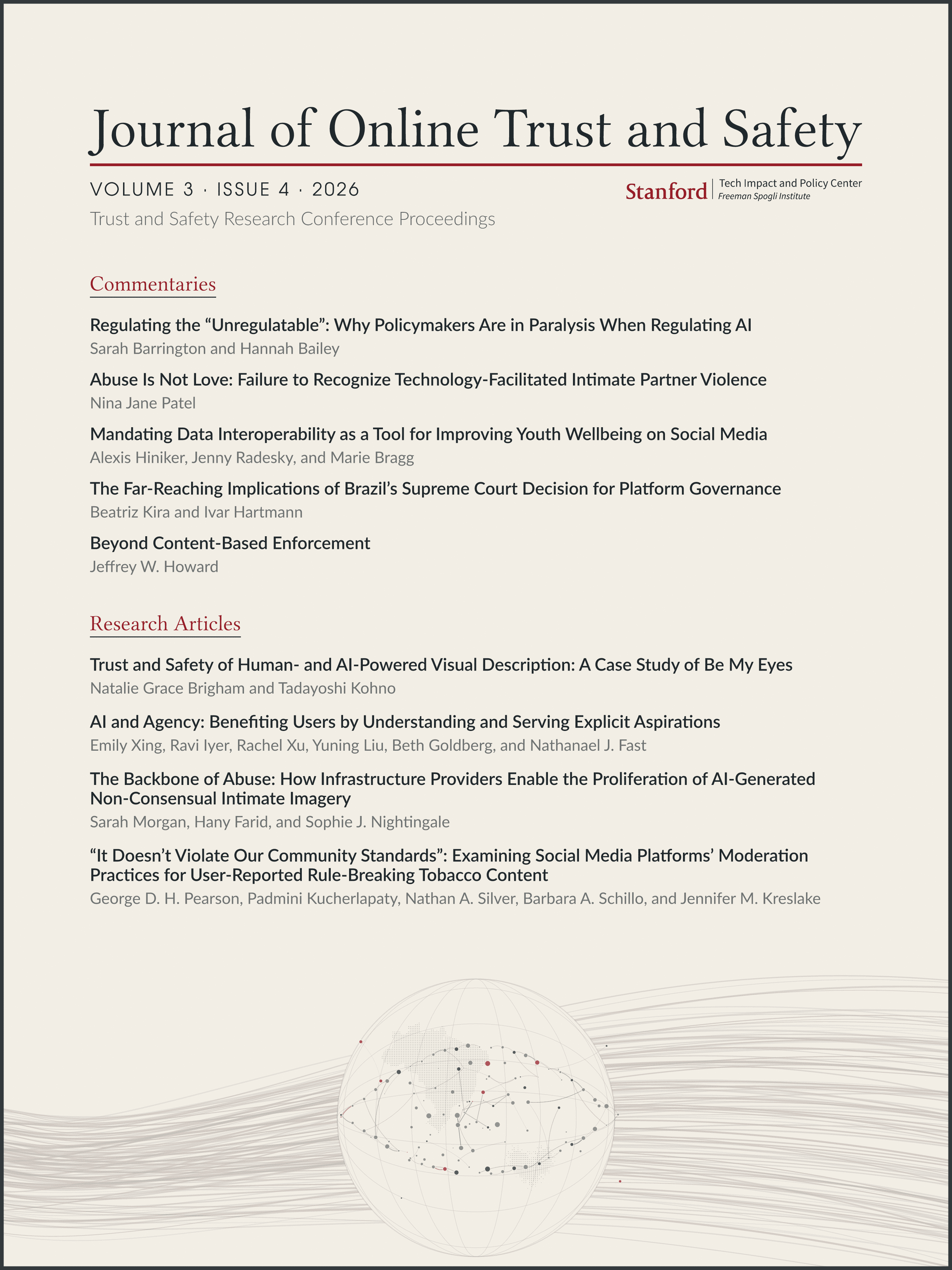
Cover of the Journal of Online Trust and Safety, Volume 3, Issue 4, 2026. The journal's name runs across the top in a large serif face over a thin red rule. Below it, on the left, "Volume 3 · Issue 4 · 2026" in spaced small capitals and the subtitle "Trust and Safety Research Conference Proceedings" in light gray; on the right, the Stanford Tech Impact and Policy Center, Freeman Spogli Institute wordmark. The contents follow in two sections with red serif headings. Under "Commentaries": "Regulating the 'Unregulatable': Why Policymakers Are in Paralysis When Regulating AI" by Sarah Barrington and Hannah Bailey; "Abuse Is Not Love: Failure to Recognize Technology-Facilitated Intimate Partner Violence" by Nina Jane Patel; "Mandating Data Interoperability as a Tool for Improving Youth Wellbeing on Social Media" by Alexis Hiniker, Jenny Radesky, and Marie Bragg; "The Far-Reaching Implications of Brazil's Supreme Court Decision for Platform Governance" by Beatriz Kira and Ivar Hartmann; and "Beyond Content-Based Enforcement" by Jeffrey W. Howard. Under "Research Articles": "Trust and Safety of Human- and AI-Powered Visual Description: A Case Study of Be My Eyes" by Natalie Grace Brigham and Tadayoshi Kohno; "AI and Agency: Benefiting Users by Understanding and Serving Explicit Aspirations" by Emily Xing, Ravi Iyer, Rachel Xu, Yuning Liu, Beth Goldberg, and Nathanael J. Fast; "The Backbone of Abuse: How Infrastructure Providers Enable the Proliferation of AI-Generated Non-Consensual Intimate Imagery" by Sarah Morgan, Hany Farid, and Sophie J. Nightingale; and "'It Doesn't Violate Our Community Standards': Examining Social Media Platforms' Moderation Practices for User-Reported Rule-Breaking Tobacco Content" by George D. H. Pearson, Padmini Kucherlapaty, Nathan A. Silver, Barbara A. Schillo, and Jennifer M. Kreslake. Each title is in bold dark gray with its authors in lighter gray beneath. The lower third of the cover is artwork in the same muted palette: a wireframe globe drawn in thin gray lines, cut off by the bottom edge, with a dotted map of Brazil on its face, a small soft-edged halftone heart to its lower right, and a network of gray and red nodes joined by curved lines that together trace the outline of an eye. Faint fanned waves of gray and pale red lines sweep across the lower page behind and around the globe. A thin dark gray frame runs just inside the edge of the cover.
PDF

Keywords

generative AI
AI governance
technological exceptionalism
regulatory enforcement
platform governance

Categories

How to Cite

Barrington, S., & Bailey, H. (2026). Regulating the “Unregulatable”: Why Policymakers Are in Paralysis When Regulating AI. Journal of Online Trust and Safety, 3(4). https://doi.org/10.54501/jots.v3i4.364

Abstract

Policymakers confronting generative AI have often accepted a striking premise: that AI is too complex, too fast-moving, and too “unprecedented” to be governed by existing frameworks. We argue that this premise is itself part of the problem. Many harms associated with generative AI, including fraud, impersonation, deceptive advertising, and exploitative synthetic media, are not wholly new categories of threat. They are familiar harms, now produced and distributed more cheaply, more quickly, and at greater scale. To move beyond the current policy paralysis, we propose decomposing AI into three layers: the model layer, the deployment layer, and the distribution layer. Once disaggregated in this way, AI no longer appears as an ungovernable monolith, but instead as a supply chain of software products and infrastructures that already sit within consumer protection, product liability, sectoral, and platform-governance regimes. Governing actors should stop treating the absence of legal authority as the obstacle. The real challenge, we argue, is the persistence of AI exceptionalism and the resulting under-enforcement of ordinary law.

https://doi.org/10.54501/jots.v3i4.364
PDF
Creative Commons License

This work is licensed under a Creative Commons Attribution-NonCommercial-ShareAlike 4.0 International License.

Copyright (c) 2026 Sarah Barrington, Hannah Bailey